

Pizza Oven Glossary
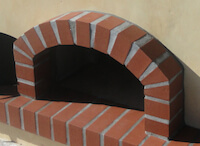
Arch
Every pizza oven has a number of pieces that can be constructed using arches, including the brick oven dome itself, which is a circular, arched vault, the opening into the pizza oven chamber, which can use either a flat or arched top, and the opening into the vent landing (the main opening you see), which can also be constructed either as a rectangle, with a flat top, or with an arch, either brick, stone, stucco or refractory material. Forno Bravo sells brick arches in our online store made from cored cut brick, rebar, and mortar. Easily installed on our modular pizza oven kits.
Barrel Vault
Barrel Vault is one way of describing a brick bread oven. This wood fired oven style has also been called a Letterbox Oven because the shape resembles a rural letterbox. The footprint of the brick oven is rectangular, and the dome is a curved vault, or barrel vault, that looks much like a Gothic Cathedral. You see this oven style in traditional French and Scottish bread ovens (which are large commercial ovens) and in the brick oven plans described in other books and websites. While this style oven works well for large-scale bread ovens, it is a poor choice for either home brick oven owners or pizzerias. The thermal mass of the oven results in long oven heat up cycles and poor fuel economy, and the shape is not suited for fire-in-the-oven cooking and pizza.
Black Oven
An oven design that features a fire-in-the-oven that heats the oven and bakes food. After the oven is fully heated, the fire is either moved to one site or removed, to enable cooking. The Black Oven contrasts the White Oven design, where a separate fire chamber below the oven cooking chamber is used to heat the oven.
Bread Oven
We like to say that it is easy to cook bread in a pizza oven, but difficult to cook pizza in a bread oven. The main characteristics of a Bread Oven are the Barrel Vault design and larger thermal mass. You find both Pizza Ovens and Bread Ovens in Italy, where Pane Cotto a Legna can still be easily found in most supermarkets, many of which have brick Bread Ovens in their bakeries. Pizzerias, restaurants, and homes all use traditional Round Pizza Ovens.
Brick
Need we say more? We recommend high-quality Firebricks for the dome and floor of the Pompeii Oven. Red clay bricks are a traditional design element for many oven finish styles, including the Vent Arch. Read our Brick Primer for more on bricks and the Pompeii Oven.
Carbon Burn-Off
When the inside of the Dome of a pizza oven reaches about 650°F, the black soot, or carbon, begins to burn off, giving the impression that the oven dome is turning white, or clear, You can see the detail of the dome interior, and know that your oven is nearly ready for cooking pizza and that it has reached a stage where it will continue to hold heat for other types of retained heat cooking. With Forno Bravo and Pompeii ovens, this takes an hour or less, depending on the oven model.
Cart Oven
Cart ovens are prevalent in and around Naples, where they are used for catering parties and outdoor festivals (of which there are a lot), and for neighborhood entertaining. Our view is that the nature of entertaining, houses and roads in the U.S. lend themselves more toward Trailer Ovens for catering, parties, and events.
Catering Oven
We use this term to describe any portable or mobile pizza oven, that is used for catering events, parties, and festivals.
Ceramic Insulation
Alumina-Silica insulating boards and blankets are the most efficient material available for pizza oven insulation. Heat resistant to over 2,300ºF, ceramic fiber boards and blankets offer extremely low thermal conductivity and are twice as efficient as Insulating Concrete based on either Vermiculite or Perlite. Ovens insulated with 100% ceramic insulation provide faster oven heat up, better heat retention, and use less space.
Chimney
Unlike a Fireplace, where the chimney is in the back, a Pizza Oven has the chimney outside of the fire chamber — the front. The oven draws in cold air through the oven opening for the fire and exhausts hot air back out through the top half of the oven door. The exhausted air is collected by a Vent, which in turn connects to a chimney. Outdoor ovens use a short chimney run to safely exhaust smoke while indoor ovens can be connected to an appropriate chimney system to exhaust smoke outside of the house or restaurant. It is interesting to note that while very rustic ovens do not have a Vent and Chimney, and subject the chef to lots of heat and smoke, the ancient Pompeii Ovens had sophisticated Vent and Chimney systems and were inside shops that also served as retail outlets.
Chimney Manifold
The part of a Forno Bravo Pizza Oven that connects the Vent to a standard steel Chimney system.
Clay Brick
Basic clay brick used for construction. We do not recommend Red Clay Brick for the dome or floor of the Pompeii Oven. They are, on the other hand, beautiful and very inexpensive as a finish material.
Commercial Pizza Oven
Commercial Pizza Ovens and Residential Pizza Ovens are based on the same basic design, with the primary differences being the size of the oven, the thickness and quality of the Refractory material used, and the thickness of the Insulation material used. For example, Forno Bravo sells residential ovens ranging from 24″ to 48″, and commercial ovens ranging from 44″ to 72″. While the walls of our commercial ovens are thicker, it is important to note that the material is the same. This is critical. Many Italian refractory oven producers use a lower-grade refractory material for their home ovens and even charge a premium for their high-end residential ovens that use the higher-quality refractory material. We would not recommend using a commercial oven in a residential setting. They cost more, take longer to heat up, and use more fuel than residential models, and are designed to be fired 24/7, 365-days per year, for 15 years.
Concrete
You will end up using concrete for your stand and hearth, and possibly your trim and finish, but should never use standard concrete in any core oven components, including the Vent — which gets too hot for standard concrete. Try to avoid oven producers that provide a concrete vent, or worse, a steel venting system in the Refractory oven. The Forno Bravo Refractory ovens include a Refractory Vent constructed using the same material as the oven.
Concrete Block
These 8″x8″x16″ blocks, or Concrete Masonry Unit (CMU,) are easy to use and inexpensive ($1-3 each) for building an oven stand. For indoor installation, and builders who are looking for a faster or lighter installation method should consider a Cucina Stand or Metal Hearth Tray and stand.
Concrete Board
These pre-made sheets of concrete provide a convenient method of finishing the top of an oven when used with Metal Studs. They are non-combustible, and can use near the oven opening, and can be covered with stucco and stone. Hardibacker is a popular brand of non-combustible backer board, or concrete board.
Cooking Floor
See Oven Floor.
Corner Oven
An oven installation where the oven sits in a corner and the opening faces out at a 45-degree angle. Corner oven installations are common both in indoor and outdoor kitchens.
CMU
Concrete Masonry Unit. See Concrete Block.
Curing
After your oven has been installed, you need to bring it up to heat slowly to allow the oven itself, and the installation materials to dry. Failure to do this could result in damage to your oven. You should allow your oven to sit for seven days after installation, then begin a series of seven small, then growing fires. Read our Curing Page for additional information.
Dome
See Oven Dome.
Dome Enclosure
An oven enclosure design where the oven outer shell follows the shape of the oven dome. Also called an Igloo.
Door
There are a number of oven door designs, including a free-standing sheet metal door, a hinged and insulated door, and an owner-built wood door. You use the oven door to regulate air intake and the strength of your fire during Oven Firing, and to close the oven for Retained Heat Cooking. An insulated door improves a Pizza Oven’s ability to retain heat for longer periods of time.
Firebrick
Refractory bricks used to build the Oven Dome of the Pompeii Oven. A typical medium duty firebrick made from 30% to 35% alumina and 60% silica can withstand rapid heat-up and cool-down cycles without spalling (flaking) or cracking. Read our Brick Primer for more details.
Fire Clay Mortar
A mortar made for building the Pompeii Oven that consists of sand, fire clay (ground firebricks,) and Portland cement. Refer to the Pompeii Oven plans for more details. While not as heat resistant as true Refractory Mortar, it is easier to find.
Fireplace
An essential component of a well-equipped Outdoor Kitchen. Forno Bravo provides Outdoor Fireplace Kits made from the same Refractory Material as our Pizza Ovens.
Firenze Concept Oven
We built the Firenze Concept Oven to take some of the mystery, and perhaps fear, out of the process of installing a Pizza Oven. The installation went fast, the footprint is small, and most of all, the oven cooks great.
Foundation
Your oven will sit on a standard concrete pad. Make sure you build your foundation slightly larger than your Oven Stand, in order to support your finish material, and forms you will use to install our Insulating Hearth. Consider sloping the foundation just slightly to the front of the oven, to keep water from standing in your wood storage area underneath the oven. Your hearth and Oven Floor will be level.
Gabled Enclosure
A form of outdoor oven enclosure that features a basic walled structure and gabled roof. A traditional Mediterranean finish style.
Hearth
See Insulating Hearth.
Hipped Enclosure
A form of outdoor oven enclosure that features a basic walled structure, hipped roof, and a chimney centered over the oven dome. A traditional Mediterranean finish style.
Igloo
A form of outdoor or indoor Pizza Oven enclosure where the exterior oven walls follow the basic shape of the oven chamber to form an Igloo, Dome, or Beehive. Also a traditional Mediterranean finish style.
Insulating Blanket
Modern, high-tech woven ceramic insulation that comes in blanket form, and wraps around your Forno Bravo or Pompeii Pizza Oven dome. Lightweight and highly efficient, 3″ to 6″ of Blanket Insulation comes standard with each Forno Bravo Oven.
Insulating Board
Modern, high-tech woven ceramic insulation that comes in board form, and is installed under your Forno Bravo or Pompeii Pizza Oven dome. Lightweight and highly efficient, 2″ to 4″ of Board Insulation comes standard with each Forno Bravo Oven.
Insulating Concrete
A mix of six parts Vermiculite or Perlite to one part Portland cement that makes an insulating product which can be used in the Insulating Hearth and for dome insulation in certain types of enclosure. Insulating concrete is less efficient than ceramic insulation.
Insulating Hearth
A two-part hearth that supports your Pizza Oven, and provides both an Insulation layer and structural support. Comprised of either a standard concrete slab or metal tray and Insulating Board, the Insulating Hearth enables your oven to hold heat for better cooking and better efficiency with fuel.
Insulation
The layers that enclose your Pizza Oven dome and floor, and stops heat from escaping. Without proper insulation, heat will conduct through the Oven Hearth and Oven Enclosure, making the outside of the oven hot to touch. A poorly insulated oven will not retain heat well for baking and roasting.
Landing
Your pizza oven has two landing areas. The smaller space directly in front of the oven door and below the Vent, called the Vent Landing, and a larger area at the front of the oven, called the Oven Landing. The Vent Landing is included with all Forno Bravo pizza ovens.
Metal Stud
Metal studs used for building outdoor and indoor partition walls using Concrete Board. Can be used instead of half-wide Concrete Blocks or Bricks to finish the top of an outdoor Pizza Oven installation.
Metal Hearth Tray
A metal tray that holds the Insulating Hearth, and can be used in place the forms that hold a site-built Hearth. A metal hearth tray can be used with metal legs, a metal stand frame, or with a concrete block stand.
Modular Pizza Oven
Modular Pizza Ovens are shipping disassembled in order to simply shipping and installation, and to give the owner more control over the installation process and finish details. The individual pieces of a Modular Pizza Oven are small enough to be easily moved by two people, and do not require the owner to remove fencing or doors to install a Pizza Oven. The Modular approach is the most commonly used in Italy.
Mortar
There are three types of mortar, at least for the purposes of installing a Pizza Oven or Refractory Fireplace. Refractory Mortar, a pre-mixed, heat resistant mortar engineered for Pizza Ovens and Fireplaces and provided with every Forno Bravo oven; Fire Clay Mortar, a site-mixed mortar based on sand, fire clay, and Portland cement used by some Pompeii Oven builders; and standard Mason’s Mortar. Do not use mason’s mortar for your Pizza Oven chamber and vent, and only use it for decorative elements that do not get hot.
Napoletana Oven
A style of Pizza Oven that features a lower Oven Dome height and more aggressively curved dome shape — seen in and around Naples and in ovens built by Neapolitan builders throughout Italy. It is said to be tuned for cooking Verace Pizza Napoletana. The Forno Bravo Casa2G, Premio2G, Professionale and Modena2G ovens are in the Napoletana, or Neapolitan, style.
Outdoor Kitchen
The Outdoor Kitchen can range from a simple Pizza Oven or grill to a completely outfitted kitchen and dining room featuring a Pizza Oven, stainless steel grill, cooktop, refrigerator, sink, and more. The Outdoor Kitchen has been a part of Mediterranean living for centuries, and is really catching on in the states — for good, reason. It’s the best way to cook and eat when it’s hot (and even when it isn’t). See our Photo Gallery for Outdoor Kitchen Design ideas.
Oven Brush
A soft copper or brass brush used for cleaning your Oven Floor.
Oven Dome
The curved vault of the Pizza Oven. The parabolic, round shape of the dome is efficient with wood fuel, and evenly reflects heat back down on the Oven Floor for cooking perfect pizza and other dishes that use both top and bottom heat for cooking. There are two basic types of Italian Oven Dome: the Napoletana Oven and the Tuscan Oven.
Oven Enclosure
The structural and decorative components of the pizza oven that provide the hearth, or base, for the oven, and the walls that enclosure the insulation. An outdoor oven enclosure must be waterproof. The oven enclosure is typically made of the oven, the oven legs, the oven tray, or hearth, and the enclosure walls.
Oven Firing
The fire inside the oven chamber that heats the refractory material that comprises the oven. Make sure you know how long it takes to fire your oven for the type of cooking you are going to do, so you can plan ahead and fire your oven at the right time. For more, read our Pizza Oven Management page.
Oven Floor
The floor of a Pizza Oven can be made either from prefabricated circular pieces (typically pie-shaped), bricks, or refractory tiles. If it is at all possible, it is better to choose an oven where the Oven Dome wraps around the oven floor, and rests on the Insulating Hearth. This keeps heat inside your oven, and keeps it from “leaking” out the side of the oven through the exposed sides of the oven floor. You cook pizza and bread directly on the oven floor, and set pots, pans and grills on it for other cooking effects.
Oven Landing
The area in front of our oven where you place food going in and out of the oven. Often the size and material of the Oven Landing is up to the design of the owner, and ranges between 4″ and 24″.
Oven Opening
The door into your oven chamber. The size of the opening is designed to be large enough to accommodate pots, pans, grills, and of course pizza, without being so large that the oven does not hold heat.
Oven Stand
The “legs” that your Pizza Oven rests on. Typically Concrete Block for site-built installation, and optionally metal for light-weight installations and rapid installations.
Perlite
An insulating material that can be mixed with Portland cement to make Insulating Concrete, or poured loose around the Oven Dome. Similar to vermiculite, these materials are less efficient than ceramic insulation.
Pizza Oven
A traditional, round-domed Italian wood fired oven optimized for baking pizza, roasts, vegetables, and hearth bread from a single firing.
Pizza Peel
The tool you use to set and turn pizza, and the pots and pans to put in and out of your Pizza Oven. They can be either wood or steel, short-handled or long-handled. For more information on technique, read our Using Pizza Peels page.
Pompeii Oven
The Pompeii Oven is a set of free plans that describe how to build a traditional round Italian brick oven. The oven is built using Firebricks and materials easily found at Home Depot and other building supplies stores. It’s a great oven, and a great project, though a definite labor of love.
Portland Cement
Pure cement—kiln-dried limestone, without any of the aggregates that make up concrete. Used in various ways in Pizza Oven installation, including Insulating Concrete and Fire Clay Mortar.
Prefabricated Oven
See Modular Pizza Oven.
Refractory
Material that is designed to withstand heat and high temperatures. The Refractory Material that Forno Bravo uses for its Pizza Ovens and Refractory Fireplaces is a high-tech composite of tempered alumina and woven ceramic silica. For more, read our Engineered Refractory Material primer.
Refractory Fireplace
Unlike a typical fireplace, where all of the heat goes up the chimney, a Refractory Fireplace uses Refractory Material to absorb and reflect heat into the space in front of it. For example, the Forno Bravo Outdoor Fireplaces are constructed using the same Refractory Material as our Pizza Ovens. They hold heat for hours — even after the fire has gone out, which is both ascetically pleasing and practical.
Refractory Mortar
True Refractory Mortar is made from Alumina Silicates and has the same, or similar, heat resistance, and thermal characteristics as the Refractory Pizza Oven itself, making it the right mortar for Pizza Oven and Outdoor Fireplace installation.
Residential Pizza Oven
Residential Pizza Ovens are designed for home and garden use and have a number of defining characteristics. They are smaller in size and slightly lighter in weight than their Commercial siblings. Their lower Thermal Mass and high-tech Refractory Material enable them to heat up very quickly, typically between 30 and 60 minutes, making it practical to use them often during the week.
Retained Heat Cooking
This is the style of cooking where you rake the fire and coals out of the Pizza Oven, and cook using the heat held in the Refractory Material. You can cook a wide range of foods this way, taking advantage of the various levels of heat the oven goes through as it cools. For example, you can cook bread at around 500F, roasts, cakes, and other Dolce around 400F, then beans and soups overnight as the oven temperature falls. For more, read our Brick Oven Cooking Techniques pages.
Round Pizza Oven
The round Oven Floor and parabolic Oven Dome are two of the main characteristics of an Italian Pizza Oven.
Stand
See Oven Stand.
Thermal Layer
The thermal layer includes all of the material in the Pizza Oven that absorbs and retains heat for cooking, or is exposed to fire and high temperatures. It typically include the Oven Floor, Oven Dome, and Oven Vent.
Thermal Mass
Thermal mass describes the volume of refractory material in your oven that you have to heat up in order to prepare your oven to cook. One interesting characteristic of thermal mass, like most things in nature, is that it demands equilibrium. If one side of a thermal mass is hot and the other side is cool, such as a Pizza Oven when it is first being fired, heat will migrate from the hot inner edge of the mass to the cool outer part of the oven in order to reach equilibrium—leaving the entire mass only “warn”. This means that you cannot heat only the “inside” of your oven, and that ovens with a large thermal mass will take a long time to heat up, as nature tries to heat the entire mass evenly. That is one of the reasons why you should not use a bread oven for cooking pizza at home, and why you typically should not use a Commercial Pizza Oven for home baking. The thermal mass of each Forno Bravo oven is tuned to its specific task.
Thermocouple
A small probe and wire cable you can install with your Pizza Oven that will output the temperature of the oven at that spot in the oven to a temperature display.
Thermometer
Temperature is always an interesting topic with wood-fired ovens. You can test the temperature of the inside of the oven dome, the floor of the oven, a couple of inches inside the oven dome, and in the air, using a variety of thermometers and Thermocouples. For example, the Premio oven tests the air temperature, which allows you to gauge the temperature of the dome and floor. Another option is to use a Non-Contact Thermometer, which tests the surface temperatures of the Oven Floor and Oven Dome (if you have the right model). Bakers using larger, thicker, Bread Ovens test inside the refractory to see how much heat has been absorbed to gauge the oven for bread. Another option is to develop a “feel” for your own oven using your hand. For more, read our Pizza Oven Management page.
Trailer Oven
Forno Bravo partners build Pizza Ovens installed on trailers, for use as Catering equipment.
Tuscan Oven
The Tuscan Oven features a slightly higher Oven Dome and less aggressive inward slope than the Napoletana Oven. While it may provide slightly better heat retention for baking and roasting, the Tuscan and Napoletana designs are very similar overall and cook in very similar ways.
Vent
The Vent rests just in front and above the Oven Opening, and collects the smoke and hot air that is exhausted from the top half of the opening. It is typically important to note that this part of the oven gets very hot, and if possible, should be built using true Refractory Material. The Forno Bravo ovens feature a two-piece refractory vent that can be used with both steel Chimney systems and terra cotta flue liners. That said, certain Neapolitan Ovens use an external steel or cast iron Vent that is attached to the outside the Oven Dome, a style you see with our Forno Bravo Artigiano.
Vent Arch
The arch that you see in the front of most ovens is, in fact, a non-structural, decorative Vent Arch, which encloses the Vent and Vent Landing. With certain Neapolitan Ovens, such as the Forno Bravo Artigiano, you can see the actual Oven Opening, and the vent is attached above, like an indoor oven hood.
Vent Landing
The small landing directly in front of the Oven Opening.
Verace Pizza Napoletana
The Verace Pizza Napoletana specification was originally created at a meeting of Naples’ most venerated Pizzaioli, who came together to define the perfect pizza — they even signed a public declaration supporting the specification. Today, there are two aspects to VPN. First, there are non-profit certification companies, whose goal is to promote Italian pizza and protect the “brand” of Pizza Napoletana. Second, there is a move by the Italian Ministry of Agriculture to have Verace Pizza Napoletana accepted by the EU as a protected product. What we think is most interesting about the story is that these efforts clearly outline what Italy, and more importantly the Napoletana, think a real pizza should look and taste like. For more, read our translation of the Verace Pizza Napoletana Specification presented to the EU.
Vermiculite
An old-fashioned, inexpensive Insulator. A different product with similar qualities to Perlite.
Vermiculite Concrete
See Insulating Concrete.
Wall Oven
A Pizza Oven set behind a partition wall — either indoor or outdoors.
White Oven
A white oven features a separate firing chamber below the oven cooking chamber, where the heat of the fire is vented into the cooking chamber. White ovens are typically used by commercial bread bakeries.